Anterior
Siguiente
Top 10 European Countries for Data Centers (2026)

Top 10 European Countries for Data Centers (2026)

|

16/2/2026

-

min

Top 10 European Countries to Build Data Centers (2026 Investment Analysis)

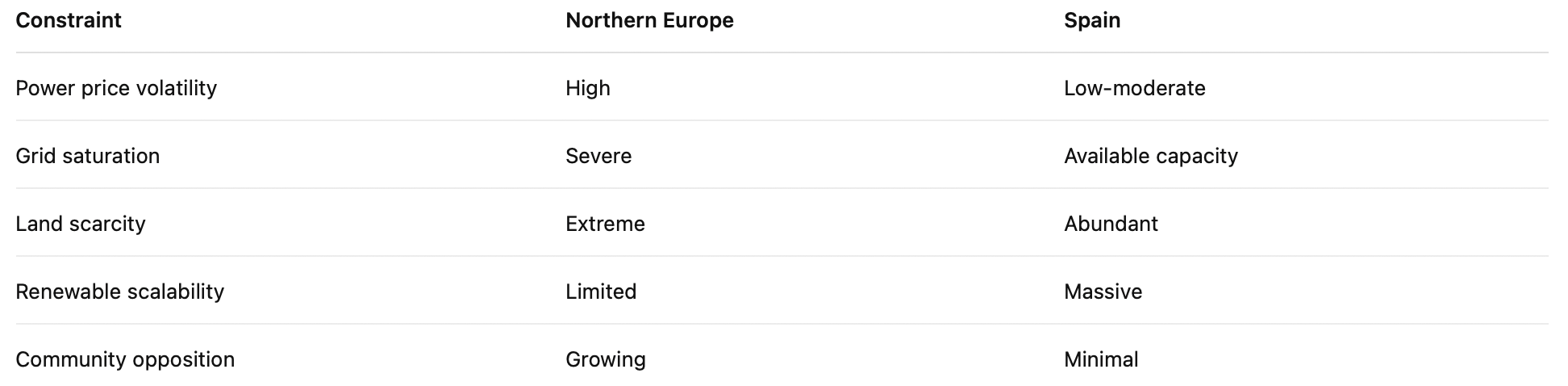
The European data center market is entering its most capital-intensive expansion cycle in history. AI workloads, sovereign cloud regulations, edge computing and GPU-driven demand are pushing hyperscalers and infrastructure funds to search for new geography beyond traditional FLAP-D hubs (Frankfurt, London, Amsterdam, Paris, Dublin). Power constraints, land scarcity, grid saturation and political pushback have transformed site selection from a networking decision into a complex energy-infrastructure investment thesis.

This report ranks the 10 best European countries for building data centers — from an investor’s perspective — based on:

Evaluation criteria (weighted):

  • Power availability & price (30%)
  • Renewable capacity & ESG viability (15%)
  • Fiber connectivity & latency corridors (15%)
  • Land cost & scalability (10%)
  • Cooling climate efficiency (10%)
  • Regulatory predictability (10%)
  • Fiscal incentives (5%)
  • Political & geopolitical stability (5%)

1. Spain — The New Hyperscale Frontier (Winner)

Spain is rapidly transitioning from a regional colocation market into a Tier-1 European digital infrastructure platform.

The country solves the three constraints that now define hyperscale expansion:

The Structural Advantage: Energy Economics

Spain has one of the largest renewable pipelines in Europe:

  • Massive solar overcapacity (daytime negative pricing events already occur)
  • Expanding wind generation corridors
  • Hydroelectric reserves for stability
  • Direct PPA contracts widely accessible

For hyperscalers, energy is 60-75% of operating cost.

Spain offers the most scalable renewable PPA market in Western Europe — critical for AI training clusters exceeding 100 MW per campus.

Why Spain Works for AI Data Centers

AI infrastructure changes location logic:

Old model → low latency to financial exchanges

New model → cheap green power + large land parcels + fiber backbone

Spain sits at the intersection of:

  • Atlantic submarine cables (USA-Europe-Africa-LATAM)
  • Mediterranean digital corridor
  • Iberian renewable supergrid

It is becoming the energy battery of Europe’s digital economy.

The Hidden Opportunity: El Bierzo (Castilla y León)

The most economically attractive micro-region in Western Europe for hyperscale campuses

Investors typically analyze countries.

The real alpha lies in micro-geography — and El Bierzo is one of the strongest undiscovered locations.

Key Competitive Advantages

1) Ultra-Low Land Cost with Industrial Zoning

Typical hyperscale campus requirement: 40-120 hectares

This alone reduces capex per MW by millions.

2) Ideal Climate for Cooling Efficiency

Data centers spend massive electricity on cooling (PUE impact).

El Bierzo characteristics:

  • Atlantic-continental hybrid climate
  • Cooler average temperatures than Madrid
  • High night cooling window
  • Low extreme heat frequency
  • Excellent free-cooling potential >60% of the year

Result:

Lower OPEX and improved ESG scoring.

3) Power Availability Without Grid Congestion

Major European hubs face connection delays up to 7-10 years.

El Bierzo offers:

  • Proximity to large hydroelectric infrastructure
  • Nearby wind corridors
  • Transmission capacity underutilized after industrial decline (mining era legacy grids)

This is exactly what hyperscalers seek: “brownfield power without brownfield pollution.”

4) Fiber Backbone Position

El Bierzo sits on a natural digital corridor:

Madrid ↔ Galicia submarine cables ↔ Northern Europe routes

Latency impact:

  • Near-metro edge access
  • Excellent backbone routing
  • Suitable for AI training clusters + edge inference nodes
5) Economic Incentives

Castilla y León qualifies as a priority reindustrialization region.

Typical support mechanisms:

  • Regional subsidies
  • Fast permitting
  • Reduced property tax
  • Industrial employment incentives
  • EU structural funds eligibility

For a 100 MW campus, incentive impact can reach 8-15% capex reduction.

Investment Thesis

El Bierzo is not just cheap land.

It represents a rare alignment of:

  • energy surplus
  • fiber access
  • political alignment
  • cooling efficiency
  • regional incentives

In infrastructure investing terms: it is a pre-cluster location before market repricing.

2. Norway

Best in class for hydro power and sustainability branding.

Pros:

  • Near-zero carbon intensity
  • Cold climate
  • Government support

Cons:

  • Remote latency
  • Limited fiber density
  • Smaller talent ecosystem

Ideal for archival cloud, not ideal for latency-sensitive workloads.

3. Sweden

A major hyperscale hub for Big Tech expansions.

Strengths:

  • Cold climate
  • Stable regulation
  • Renewable grid

Weakness:

  • Market already discovered → rising land cost

4. Finland

Becoming the Nordic GPU training hub due to:

  • Abundant land
  • Cooling efficiency
  • Stable grid

But limited southern European latency reach.

5. France

Strong nuclear baseload power.

Problems:

  • Bureaucratic permitting
  • Social opposition
  • Expensive land

6. Italy

Emerging southern edge computing market.

Strength:

  • Mediterranean connectivity
  • Underpenetrated

Weakness:

  • Energy price volatility
  • Regulatory unpredictability

7. Portugal

Similar thesis to Spain but smaller scale.

Advantage:

  • Atlantic cable landing points

Constraint:

  • Grid capacity smaller

8. Poland

Eastern European digital hub.

Pros:

  • Land availability
  • Growing demand

Cons:

  • Carbon heavy energy mix (ESG risk)

9. Ireland

Traditional hyperscale giant now constrained.

Critical issue:

Power grid moratoriums in Dublin

Growth shifting elsewhere.

10. Germany

Europe’s largest data market but saturated.

Frankfurt limitations:

  • Power scarcity
  • Extreme land cost
  • Community pushback

Future expansion requires secondary cities.

Final Ranking Summary

Ranking best locations for data centers in europe 2026

Conclusion: Why Spain — and El Bierzo — Could Become Europe’s Next Hyperscale Cluster

The European data center industry is shifting from network-centric to energy-centric geography.

The winning locations are no longer financial capitals but energy capitals.

Spain offers:

  • renewable scale
  • geographic centrality
  • political support
  • expansion capacity

El Bierzo adds:

  • extreme cost efficiency
  • cooling performance
  • grid headroom
  • incentive alignment

From an investment perspective, the region fits the classic infrastructure opportunity:

High future demand + current underpricing + physical constraints elsewhere = cluster formation probability

The most valuable data center markets in Europe were once rural regions before hyperscalers arrived.

El Bierzo currently sits at that exact stage.

Ir al enlace

Artículos relacionados

Miniatura del artículo

AI and Personalization in Home Services: The Next Frontier in Customer Experience

In today’s fast-paced digital environment, the home services industry is undergoing a significant transformation, thanks to advancements in artificial intelligence (AI) and data analytics. This article explores the revolutionary impact of AI-driven personalization on customer experience within the home services sector, detailing how companies like Wolly are at the forefront of this change.

|
31/3/2025
-
VER más
Miniatura del artículo

The Rise of Smart Home Integration in PropTech: How Wolly is Leading the Charge

As technology continues to permeate every aspect of our lives, the concept of smart homes has evolved from a futuristic vision into a tangible reality. This integration of technology in residential spaces is not just enhancing comfort but also transforming how home services are managed and delivered. In this context, Wolly's innovative approach in PropTech is setting new standards for smart home integration, making it an essential study for those invested in the future of home management.

|
11/4/2025
-
VER más
Miniatura del artículo

Revolutionizing Property Claims: How AI-Powered InsurTech is Transforming Home Insurance Services

The insurance industry, particularly in the realm of home services, is undergoing a significant transformation thanks to advancements in artificial intelligence and digital technologies. This evolution marks a pivotal shift from traditional, often cumbersome claim processes to streamlined, efficient services that benefit both insurers and policyholders alike. In this article, we delve into how AI-powered InsurTech is revolutionizing property claims, focusing on its impact on efficiency, customer satisfaction, and operational costs, while highlighting Wolly's innovative role in this sector.

|
23/5/2025
-
VER más