Cognigy vs SmartComm vs Kore.ai vs Yellow.ai – 2025 Comparison
Wolly Redacción
|
1/9/2025
-
min
Cognigy vs Wolly SmartComm vs Kore.ai vs Yellow.ai – The 2025 AI-Human Communication Orchestration Platform Showdown
Discover the ultimate 2025 comparison of AI-human communication orchestration platforms. Pros, cons, scope, and real use cases.
Introduction
Conversational AI has moved far beyond simple chatbots. In 2025, companies demand full AI-human communication orchestration platforms capable of managing interactions across multiple channels, maintaining context, and enabling seamless collaboration between AI agents and human teams.
In this article, we compare four of the most relevant solutions in the market: Cognigy, Wolly SmartComm 4.0, Kore.ai, and Yellow.ai — breaking down their strengths, weaknesses, scope, and real-world applications so you can choose the right fit for your business.
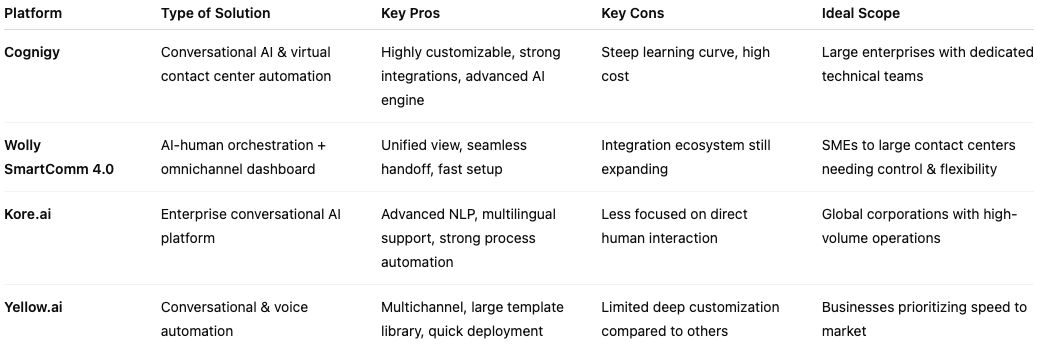
Quick Comparison Table
Comparison Table AI-Human Communication Orchestration Platform
1. Cognigy
Overview: Cognigy is a conversational AI and virtual contact center automation platform favored by large enterprises with complex infrastructures. It integrates deeply with CRMs, ERPs, and enterprise workflows.
Pros:
Advanced AI engine with high-level NLP.
Extreme flexibility in conversation flows.
Deep integrations with major enterprise systems.
Cons:
Steep learning curve for non-technical teams.
Higher cost, especially for SMEs.
Requires dedicated technical staff to fully leverage.
Best for: Large corporations with mature tech ecosystems.
Overview: SmartComm is the first omnichannel AI-human orchestration system with a single unified dashboard. It enables businesses to monitor, intervene, and coordinate AI and human agents in real time across all active channels.
Pros:
Unified command center for WhatsApp, WebChat, and calls.
Seamless AI ↔ human handoff with full context preservation.
Setup in minutes — no advanced technical skills needed.
Live analytics: sentiment tracking, instant summaries, smart alerts.
Cons:
Integration ecosystem still expanding.
Currently focused on digital channels (email & social media coming soon).
Best for: From startups and SMEs to large contact centers needing full control, speed, and scalability.
3. Kore.ai
Overview: Kore.ai is an enterprise-grade conversational AI platform specializing in process automation and multilingual, omnichannel deployments.
Pros:
Excellent multilingual capabilities.
Integrations for both voice and chat channels.
Strong automation features for enterprise workflows.
Cons:
Less emphasis on real-time human collaboration.
Complex to customize for highly specific use cases.
Best for: Global organizations with large-scale customer operations.
4. Yellow.ai
Overview: Yellow.ai offers conversational and voice bot automation with a focus on fast implementation and broad multichannel support.
Pros:
Works across voice, chat, and messaging platforms.
Large library of pre-built templates.
Fast time-to-market.
Cons:
Limited deep customization compared to competitors.
Weaker in advanced AI-human orchestration.
Best for: Companies that need to launch bots quickly with moderate customization.
Conclusion: Which Should You Choose?
If your priority is maximum customization and you have a strong technical team, Cognigy and Kore.ai are solid enterprise-level picks. If you value speed and quick multichannel deployment, Yellow.ai is a fit. But if your goal is to gain complete control over all communications, with AI and humans working in perfect sync inside a single, real-time omnichannel dashboard, Wolly SmartComm 4.0 offers the best balance of usability, scalability, and cost-effectiveness.



.png)

.jpeg)
